There are probably easier ways to build a readership than writing about local government, let alone a local government budget, and yet here we are, taking a closer look at the budget the Northbrook Village Board approved in early April.
Word of warning: this is a substantially long piece but one that I hope every resident reads and shares with others.
The budget is certainly a financial document, a 384-page behemoth at that. But it is also one of the best available guides to how the Village actually functions. Department by department, it lays out what Northbrook believes it accomplished last year, what it wants to do next, how it is staffed, what it measures, what it spends, and how those choices are funded. In that sense, it functions more as a Village operating manual than a static spreadsheet.
After reading it carefully, I came away with the following:
This budget reflects a Village that is financially well-managed, but we are at a precarious point in the evolution of our community. We will face increasing cost pressure that needs to be offset by more sales tax revenue or higher property taxes, driven by pension funding gaps and the massive, long-overdue facility upgrades we are managing to tackle all at once. Our sales tax revenue increasingly depends on online sales (largely taxing ourselves), we have been told to expect no progress on Northbrook Court anytime soon, and our downtown revitalization plans are not progressing. Although the budget adds an Economic Development Coordinator this year, the role is buried so far in the organizational structure that I am not confident we will get substantial lift in the short run. As a result, I would expect property tax bills to keep rising.
Furthermore, I am certain most residents have no idea what is happening. We had zero public comment on a $180 million budget and zero public comment on a 12.3% property tax levy, which is unsurprising given the ludicrous level of engagement by the collective electorate.
I can understand our elected leadership's frustration with the lack of engagement even as they share accountability for our current situation. They too rarely effectively convey their thinking to the public. Nature abhors a vacuum, and when Village leadership does not craft the narrative, residents will fill it in on their own, even if they did not do their part in the process. At some point, rising tax bills have a way of turning disengaged residents into very engaged ones, and future boards may find that tipping point arrives sooner than expected.
Deep breath. Let's dive into the details.
What follows:
- How the budget is organized
- How it is built and ultimately approved
- Some interesting factoids
- A deeper dive into seven things that caught my attention
How the Budget Is Organized
Naturally, the proposed fiscal year 2027 budget begins with an award.
Before the reader even gets to the table of contents, Northbrook notes that it received the Government Finance Officers Association's Distinguished Budget Presentation Award on May 1, 2025. The award recognizes budgets that function as a policy document, financial plan, operations guide, and communications tool, while satisfying fourteen mandatory criteria.
A quick look at the 2025 GFOA budget award winners suggests that while the Distinguished Budget Presentation Award is legitimate, it is not especially rare around here. Illinois alone has 120 winners, and the list includes many nearby governments and public entities, including Deerfield, Glenview, Wilmette, Winnetka, Skokie, Evanston, Highland Park, Lake Forest, Arlington Heights, Buffalo Grove, Park Ridge, Des Plaines, Naperville, and Schaumburg.
The award does appear to reflect real professionalism and effort in how a budget is prepared. It is meaningful recognition, even if common among well-run suburban governments in this region. Still, there is a certain local-government bravado in opening a new budget by first pointing to awards earned by earlier ones.
The headline is that the fiscal year 2027 budget proposes $180.2 million in total spending across all funds, up from $168.3 million the prior year, an increase of about $11.9 million, or roughly 7 percent.
The underlying story is fairly straightforward: this budget is larger because the Village is paying more for pensions, debt, operations, and buildings. The property tax levy increased by $2.8 million, or 12.3 percent, to help cover police and fire pensions, debt service, and higher operating costs.
For the General Fund specifically (the $73.4 million fund that covers day-to-day Village operations), the two largest revenue sources are sales tax at $23.8 million (32.4%) and property tax at $21.5 million (29.3%). Other taxes, including state income tax and utility taxes, account for another 15.8%. The remaining revenue comes from charges for services, permits, fees, and other sources. The near-equal dependence on sales tax and property tax is worth understanding: sales tax is driven by commercial activity and can grow if Northbrook attracts more spending, while property tax is largely fixed and falls directly on residents and businesses. That balance is why attracting more businesses and more non-resident spending in the Village is so impactful to our future tax bills.
The budget is also the first one meaningfully tied to Northbrook's "first-ever" strategic plan, which lays out five draft priorities: connected community, public and community safety, economic vitality, infrastructure, and organizational excellence.
Here is how the document breaks down the details of that topline:
- Introduction (35 pages) — who runs the Village, community context, the strategic plan, staffing summaries, and a sample property tax bill
- Budget Summary (27 pages) — the top-level financial picture: levy, revenues, spending, and debt across all funds
- General Fund (164 pages, $74.3 million) — the heart of Village operations: administration, police, fire, public works, planning, finance, and IT
- Capital Projects Funds (11 pages, $52.7 million) — major building and infrastructure work including the public safety facilities
- Debt Service (4 pages, $7.1 million) — what the Village owes and how it plans to pay it
- Enterprise Funds (59 pages, $23.7 million) — water, sewer, stormwater, senior housing, and parking
- Internal Service Funds (6 pages, $12.2 million) — self-insurance and employee health insurance
- Fiduciary Funds (6 pages, $15.1 million in benefit payments) — police and firefighter pension sections
- Permanent Fund (3 pages, $40,550) — the cemetery fund
- Special Revenue Funds (18 pages, $2.4 million) — motor fuel tax, affordable housing, and the business district fund
- Northbrook Public Library (8 pages, $10.8 million levy) — included because state law requires it
- Appendix (33 pages) — policies, historical tax and sales data, debt schedules, pension metrics, and staffing classifications
How the Budget Is Built and Approved
The Village built this budget through department requests that culminated with internal staff review in February, then presented it to the Administration and Finance Committee on March 10. The Administration and Finance Committee is a three-trustee body conducting the detailed budget review before full Board consideration.
The meeting ran for nearly ninety minutes and covered two agenda items: the third quarter financial results and the full fiscal year 2027 budget presentation. The meeting minutes indicated the discussion centered around overtime budgeting, special event expenses, alignment with the strategic plan, and economic indicators.
Whether the meeting involved more detailed discussion than the minutes reflect is a fair question. Minutes are often summary documents and don't capture everything said. What is clear is that between the March presentation and the April adoption, changes totaled approximately $38,000 on a $180.2 million budget, about 0.02% overall.
It is hard to know what to make of this. The process outlined in the budget document itself suggests that March is effectively the first time the full Board sees the proposed budget, which means that by the time trustees have a meaningful chance to weigh in, the document is already fully formed and a month from the vote. Substantial changes at that stage are not really feasible, and to be fair, probably should not be expected. But that also means the Board's role in shaping the budget appears largely ceremonial. The real decisions happen earlier, in the departmental request process and internal staff review, where elected officials have no formal seat at the table.
At the April Board meeting, the public hearing was opened and closed with no public comments. Not a single resident spoke on a $180 million budget that includes a 12.3% property tax increase. That is less a criticism of the Board than a reflection of how little visibility the annual budget process gets in our community despite the various avenues the Village uses to publicize the public hearing. Several trustees thanked staff for a clear and thorough budget, noted the addition of new positions, and commended the Village's overall fiscal management. The vote was 6-0.
The thanks to staff were genuine and not undeserved. The budget is well-organized and the Village's finances are sound. But it is worth noting that the public record of the approval process consists primarily of trustees complimenting the document they were about to unanimously adopt. Whether more probing discussion happened outside the formal record is possible; what residents can observe is what was said on the record.
It is also notable that the 12.3% property tax levy increase was adopted and filed in December 2025, several months before the April budget meeting. This follows Cook County filing deadlines and is standard practice in Illinois municipalities. The April budget adoption is a legally distinct step that sets the overall spending authority for the year.
The public hearing in December about the proposed tax levy lasted twelve minutes. Staff presented for four minutes. There were no public comments. The Board's recorded commentary included a clarification that the increase incorporates the elimination of the vehicle sticker program (which had only 71% compliance and high administrative fees), a reminder that the Village receives roughly 9 cents of every property tax dollar collected, with about 67 cents going to school districts, and the Village President's assurance that nobody on the Board wants to raise taxes but that the increase is essential for world-class services and that the Village has historically held taxes flat.
Anecdotally, the Village President described funding police and fire pensions as an "unfunded mandate from the state," a framing that I found odd. And she noted that construction had started on Fire Station 11, which, as of December, it had not, though it very recently did.
Re-watching the video of this portion of the meeting was a stark reflection of where civic engagement in Northbrook currently stands.
Some Interesting Factoids
Before we get into the heavier stuff, a few gems buried in 384 pages that capture the texture of daily Village life:
- Police handled 22,790 calls for service in 2025 (up from 21,787 in 2024) and processed 690 Freedom of Information Act requests (up from 491, likely driven by the new body-worn camera program)
- Fire and EMS responded to over 5,200 medical emergencies in 2025
- Retail theft dropped sharply from 98 incidents in 2024 to 47 in 2025; identity theft held steady at 99
- IT reported zero ransomware incidents in 2025
- Public Works spread 3,609 tons of salt in 2025, versus only 1,120 tons in 2024. A very different kind of winter.
- The Village maintains 17,100 parkway trees and planted 514 new ones in 2025
- The single-use bag fee budgets $140,000 in fiscal year 2027, down from $168,000 in 2026. The proceeds are dedicated to sustainability initiatives. This tax continues to perplex me to no end.
- Animal Control handled 754 calls in 2025: 364 wildlife, 295 dog complaints, 26 dog bites, and 51 cat complaints. Oh... and 2 cat bites.
The Big Picture - Seven Things That Caught My Attention
Here are some broader observations worth a deeper look, some of which will get posts of their own.
- The Village's economic incentive portfolio — and the unusual twice-amended Hometown Coffee deal at its center
- Sales tax — and why not all of it is created equal
- The corporate property tax base — and what a Northbrook Court demolition might mean
- Three facilities, four capital projects — the Village's most significant infrastructure commitment in decades
- Pensions — the central long-term fiscal challenge facing Northbrook
- Four new positions — what they are, where they sit, and what they tell us about the Village's priorities
- How a neighboring community builds its budget differently — and what Northbrook might learn from it
1. Economic Incentives: What the Village Is Investing In and Why
The budget includes an Economic Incentive Summary that lays out every active agreement where the Village shares tax revenue with a business as part of an economic development deal. There are currently seven such agreements, and together they tell an interesting story about how Northbrook thinks about attracting and retaining business.
Car Dealerships
Five of the seven agreements are with automotive dealerships, and for good reason. Dealerships are among the most valuable tenants a municipality can have from a pure sales tax standpoint. A single high-volume dealership can generate hundreds of thousands in annual sales tax, and the standard structure here (rebating half of the new tax generated above a baseline) means the Village is only sharing revenue it wouldn't otherwise have collected. Car buyers travel significant distances, generating tax revenue for Northbrook from people who will never consume its services. When structured well, these deals cost the Village nothing on net, generate meaningful long-term revenue, and make Northbrook a more attractive home for exactly this type of business.
The five dealership agreements currently active:
Ultimo Motors — The Village rebates 50% of sales tax back to the business, up to $1.5 million total. The agreement started in 2018 and runs up to ten years, with the Village currently paying about $110,000 per year.
Foley Cadillac — A 50% rebate on new sales tax generated above a 2019 baseline, up to $2.28 million total, running through 2042. Currently paying about $27,000-$30,000 per year as the business grows above its baseline.
Tesla — For every $640,000 in sales tax the Village collects from this location, the Village rebates $320,000 back to the developer, up to $1.6 million total. The fiscal year 2027 budget anticipates $640,000 in rebate payments — the largest single payout in the portfolio.
Toyota — A 50% rebate on new sales tax above $426,000 per year, up to $9.73 million total, running through 2043. This one is growing fast, budgeted at $200,000 this year, up from just $40,000 last year, which means Toyota is generating significantly more sales tax than its baseline, a good sign for the Village's long-term return.
Rivian — A 50% sales tax rebate up to $14.4 million over 15 years, once the dealership's sales tax exceeds $200,000 per year. Just getting started, with $100,000 forecasted for fiscal year 2028.
Taken together, these five deals represent a coherent strategy: use revenue sharing to attract and retain dealerships that generate large amounts of sales tax, with the Village keeping half of everything above the baseline.
Crate & Barrel
In January 2026, the Board approved a $1 million property tax rebate distributed over ten years to retain Crate & Barrel's corporate headquarters within the Village. The deal begins in fiscal year 2027 at $100,000 per year.
Losing a major employer's headquarters carries real economic consequences: jobs, spending, and community identity. This rebate comes from the Village's share of property tax rather than incremental sales tax, which involves a different set of tradeoffs, but at $100,000 per year for ten years it is a modest commitment and the case for keeping Crate & Barrel in Northbrook is straightforward.
Hometown Coffee
The seventh agreement is the most unusual on the list and the one that raises the most questions. I have written about it previously and will write more in a future post, but here is what the budget itself reveals.
In November 2024, the Village entered into a 15-year loan agreement at 6% interest, up to $1.5 million, to fund construction and renovation of a Hometown Coffee location at 1290 Shermer Road. The fiscal year 2027 budget approved on April 14 estimated that $1 million would be, or had been, disbursed in fiscal year 2026, with just over two weeks left in that fiscal year. Then, eight days after the budget was approved, the parties executed an amended agreement that removes the loan provision entirely. Was the $1 million paid out before the amendment and subsequently returned? If it had not yet been disbursed, what gave the Village the confidence to book it in fiscal year 2026 with only two weeks remaining? Did Hometown Coffee's request to restructure catch the Village completely by surprise?
Those questions plus a fuller assessment of the revised deal will get a full post of their own.
2. Sales Tax — and Why Not All of It Is Created Equal
Sales tax is Northbrook's single largest General Fund revenue source at $23.8 million, slightly ahead of property tax. The budget projects continued growth, and the overall trend is genuinely positive. But a closer look at where that sales tax comes from tells a more complicated story.
The budget includes a sales tax comparison by shopping area through December 2025. The most striking trend is the explosion in online sales tax, nearly tripling in recent years from roughly $1.5 million to over $4.2 million annually. Most commercial areas, other than Northbrook Court which no surprise continues to decline sharply, have held roughly steady or shown modest growth.
Not all sales tax is created equal. Since Illinois changed its online sales tax sourcing rules in 2020, municipalities collect tax based on where the purchaser lives. When a Northbrook resident buys something online, Northbrook gets the tax, but it is still just residents taxing themselves.
At its peak, less than 5% of Northbrook Court sales came from Northbrook residents. The other 95% was people from Deerfield, Glenview, Highland Park, and across the North Shore spending money here and generating tax revenue for services they would never use.
The hope embedded in investments like Hometown Coffee, and the urgency behind Northbrook Court redevelopment and downtown vitality, is precisely this: that a vibrant commercial district draws people in from neighboring communities and converts their spending into Village revenue. That is a fundamentally different and more powerful economic engine than residents buying things from their couches.
3. The Corporate Property Tax Base in Northbrook — and What Happens if Northbrook Court Is Demolished?
The budget includes a Principal Taxpayers table drawn from Cook County records, though it is somewhat dated. A note in the table itself acknowledges that 2023 is the most current data available. The Equalized Assessed Value (the standardized property value Illinois uses as the basis for calculating property taxes, roughly one-third of estimated market value before a state multiplier is applied) for the ten largest taxpayers in Northbrook breaks down as follows:
- Jones Lang LaSalle (commercial office buildings) — $67.4 million
- Brookfield Prop Retail / Northbrook Court Shopping Center — $46.8 million
- Willow Festival Regency (shopping center) — $35.3 million
- UL Solutions (equipment testing) — $28.8 million
- TGM Northshore LLC (real property) — $28.7 million
- Finger EPCO Northbrook (real property) — $23.3 million
- Lake Cook Road & Mid America (portion of Village Square) — $20.1 million
- Village Square of Northbrook (shopping center) — $18.9 million
- Euromarket Designs / Crate & Barrel (furniture and home décor) — $18.0 million
- Korman Lederer and Associates (shopping center) — $17.7 million
Northbrook Court carries an assessed value of $46.8 million, making it the second largest assessed property in the Village. The ten largest taxpayers combined represent $305 million in assessed value, or 9.51% of the Village's total 2023 assessed value of $3.2 billion. The Village receives slightly less than 9 cents of every property tax dollar collected, so of whatever Brookfield pays on that assessed value, the rest goes to schools, Cook County, the library, and other taxing bodies.
The 2023 figures are the last ones available, and this is the second consecutive budget to use 2023 data. The appendix shows commercial assessed value for all of Northbrook grew from $689.2 million in 2023 to $704.9 million in 2024, suggesting any Brookfield assessment appeals were more than offset by growth elsewhere. 2025 data is not yet available.
The Village President told residents at the January 2026 State of the Village to expect zero progress on Northbrook Court this year. With only a handful of tenants still operating and redevelopment evidently still a ways off, Brookfield would logically be exploring ways to lower its cost base. Have they filed appeals to have the property reassessed? We don't have current data to know. And would they consider moving more aggressively toward full demolition even while continuing to hold out on redevelopment? Under Illinois property tax law, a demolished building reverts to land value only.
A 100-plus acre site assessed at $46.8 million could drop dramatically, potentially for years even if it actually does get redeveloped. At current levy rates, a very rough estimate puts Northbrook's annual share of property tax from Northbrook Court somewhere between $400,000 and $600,000. District 28's share is considerably larger.
Losing a meaningful portion of that would hurt.
4. Three Facilities, Four Projects — and What They Will Cost
I have written about these projects twice before and there is a lot here. Northbrook's three main public safety facilities are genuinely overdue for replacement. The Fleet Maintenance Garage dates to 1956, Fire Station 11 was built in 1971, and the Police Station opened in 1974. The employees who work in them every day have borne the cost of years of delay.
All four projects are in motion at very different stages. The Fleet Maintenance Garage at 3504 Commercial Avenue recently broke ground, targeting completion by end of 2026 at an all-in cost of roughly $22-23 million. Fire Station 11 has been split into two projects: a new satellite station at 820 Dundee Road, which also recently broke ground at roughly $22 million, and a separate Fire Headquarters facility with no confirmed site and undetermined costs. The Police Station is the most complex: site selection is unresolved, the Village is still weighing whether to rebuild on Landwehr Road or find a new location, and the five-year capital plan projects $63.9 million for this project alone. Both the Fleet Garage and Fire Station 11 have already experienced delays from their original timelines.
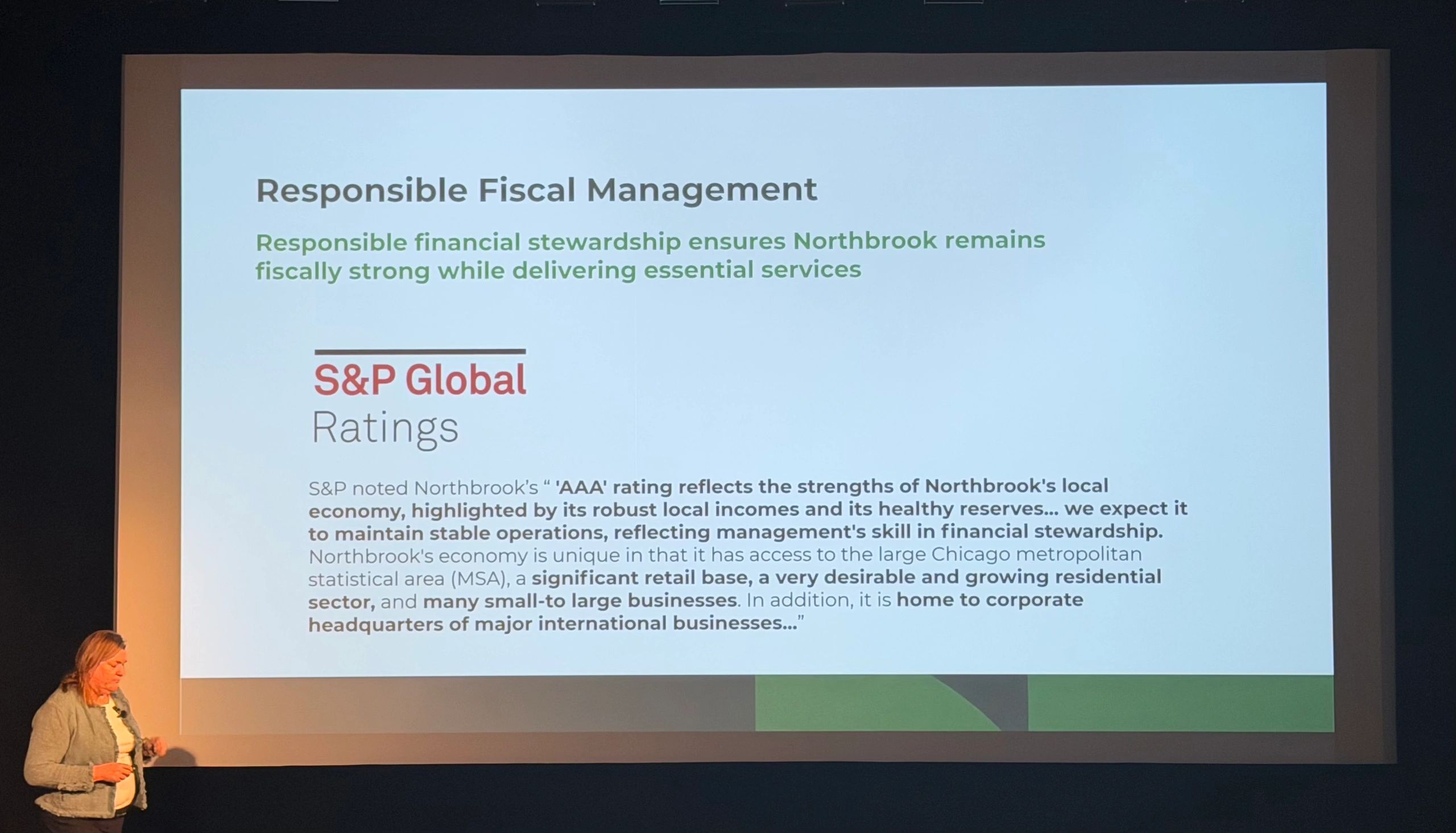
These projects are financed primarily through general obligation bonds. The Village borrows from the bond market and repays over 10 to 20 years through property taxes. Northbrook holds the highest possible bond ratings from both S&P and Moody's, which helps on borrowing costs, and has been building up a dedicated capital fund from General Fund surpluses since fiscal year 2022 to reduce how much it needs to borrow. Even so, every new bond issued adds to future annual debt service and flows directly into future property tax levies. The fiscal year 2027 budget already carries $12.8 million in annual debt service, $5.1 million of which is raised through property taxes. The total planned commitment across all four projects through fiscal year 2031 is approximately $92.6 million, with the Police Station's $63.9 million still entirely marked as "To Be Determined" for financing.
The financial burden alone is daunting. Pursuing all four projects simultaneously creates real execution risk and raises the prospect of cost pressures that could compromise the very features that make these facilities worth building. Yet the longer they go unaddressed, the more employees bear conditions that have long since stopped being acceptable. We are paying the price for past Boards that deferred these decisions for too long. The Fleet Garage and Fire Station 11 are finally moving. The far more expensive and still-unresolved work on the Police Station, and to a lesser degree Fire Headquarters, lies ahead, and the path there remains uncertain.
5. Pensions: The Long-Term Fiscal Picture
The fiscal year 2027 budget directs approximately $13.6 million into Northbrook's police and fire pension funds: $11.1 million from the property tax levy, $800,000 from the General Fund, and approximately $1.7 million in mandatory payroll deductions from officers' and firefighters' own paychecks. That compares to approximately $13.4 million in fiscal year 2026, a modest year-over-year increase that by itself does not look alarming.
As context, most private sector workers today have a 401k, a defined contribution plan where the employee determines how much, if anything, they want to contribute each year, with some employers providing matching contributions. The employee then directs those funds across a range of investment options, from conservative to aggressive, from a preselected list. The retirement benefit depends entirely on how those investments perform over time. Good market years mean a bigger retirement. Bad years mean a smaller one. The risk sits with the employee.
Police officers and firefighters in Illinois have the opposite arrangement: a defined benefit pension. The retirement payout is guaranteed, a specific monthly amount based on years of service and final salary, no matter what the market does. If the pension fund falls short of what it needs to pay those obligations, the municipality makes up the difference. The risk sits with the taxpayer. How much the Village needs to contribute each year is calculated by actuaries, professionals who model life expectancy, salary growth, investment return assumptions, and other variables to arrive at an annual required contribution. Modest changes in any of those assumptions can mean millions of dollars more or less owed each year.
Northbrook needs outstanding police officers and firefighters. These are difficult, dangerous jobs that require exceptional people willing to work 24-hour shifts, run toward emergencies, and accept significant personal risk as a condition of employment. A guaranteed pension is a meaningful and appropriate part of what makes those careers attractive. The pension obligation is not a problem to be eliminated. It is a commitment the community made to the people who keep it safe, and it should be honored fully.
The question is simply whether residents understand where this commitment currently stands and what the future implications are to their tax bills.
Illinois law, originally established in 2010 and reinforced by the 2019 consolidation legislation, requires all municipal police and fire pension funds to reach 90% funded status by 2040, with state intervention as the consequence for missing it. That same legislation created two statewide consolidated investment funds, the Illinois Police Officers' Pension Investment Fund and the Illinois Firefighters' Pension Investment Fund, into which all local pension assets were transferred. In theory, pooling assets from hundreds of small municipal funds would generate better investment returns and lower administrative costs. In practice, it meant Northbrook no longer controls how its pension assets are invested. That is now managed in Springfield. The early results were encouraging. Both funded ratios jumped significantly in 2021. But the 2022 market downturn hit hard, and both ratios fell sharply before partially recovering. The Village's annual contribution requirements are now partly at the mercy of statewide investment decisions and market volatility it cannot influence.
Worth noting that there are currently discussions in Springfield about extending the 2040 deadline to 2050, which would reduce near-term contribution pressure but also extend the period of underfunding and its associated risks.
All that said, both pension funds remain significantly underfunded relative to the state-mandated target, and closing that gap likely means sustained levy pressure for years ahead regardless of what any Board does.
As of April 2025, the police pension carries an unfunded liability of $46.5 million and is 62.9% funded. The fire pension carries an unfunded liability of $55.4 million and is 58.9% funded. Combined, Northbrook currently has approximately $101.9 million less than it will need to meet its pension obligations. Both funds were already only around 52-53% funded back in 2019, meaning this shortfall predates the current Board by many years and reflects decisions and underfunding that accumulated over decades.
To make that concrete: Northbrook has approximately 14,500 households. The $101.9 million pension gap alone works out to roughly $7,000 per household. When combined with the $92.6 million capital project commitment, the total unfunded obligation is approximately $194 million, or more than $13,000 per household. These are not abstract budget numbers. They are obligations already made that will show up in property tax bills for years to come.
It is worth noting that the Village also maintains the Illinois Municipal Retirement Fund for non-public safety employees. At 93.5% funded, it is in substantially better shape and does not face the same urgency as the police and fire funds, but it exists, it has its own annual contribution requirements, and it is part of the complete pension picture.
The Village is actively working to close the gap faster than state law requires. The Board funds pensions at 100% of the actuarially recommended amount rather than the 90% minimum, diverts surplus ambulance transport revenue ($997,000 split evenly between the two funds in fiscal year 2026) directly into the pension funds, and transfers General Fund surpluses above the 40% reserve target toward these obligations. The fund balances are projected to grow in fiscal year 2027. These are the right steps and deserve recognition.
A rough sense of the math nonetheless: the two funds currently hold approximately $158 million in combined assets against a combined accrued liability of roughly $260 million. Reaching 90% funded by 2040 means getting to approximately $234 million, closing a gap of about $76 million over 15 years, while the liability itself continues to grow as more officers and firefighters earn additional benefits. At current contribution levels and assuming investment returns meet the assumed rate of approximately 7% annually, the trajectory is plausible but offers very little margin for error. A sustained period of market underperformance, as happened in 2022, or actuarial assumption changes could require meaningfully higher contributions with little warning.
Closing a $101.9 million pension gap in 15 years while also funding $92.6 million in capital projects, on top of normal Village operations, is the central fiscal challenge facing Northbrook over the next decade. The December 2025 Truth in Taxation public hearing did at least start to outline the immediate need as the Chief Financial Officer walked through the levy components and the Village President specifically called out pension funding and public safety infrastructure. But a hearing with no public comment and little if any attendance is akin to the old saying about a tree falling in the woods.
6. The Four New Positions
The fiscal year 2027 budget adds a net four permanent positions: two strategic hires directly tied to the strategic plan (Communications Director and Economic Development Coordinator), one tactical position in support of the strategic plan (Community Engagement Specialist, not yet posted), and one operational hire (a police records clerk addressing increased workload).
At the same time, two positions were eliminated: two seasonal finance interns whose work became unnecessary after the Village ended its vehicle sticker program, and a half-time fire administrative clerk whose billing work was outsourced. Those reductions help offset the cost of the additions.
Before evaluating the positions themselves, the Village's org chart (included in the budget document) offers useful context. Org charts reflect organizational priorities, intentionally or not, and this one is worth a moment of attention.
At the top of the chart sits the electorate, Northbrook residents, who elect the Board of Trustees, who in turn hire and oversee the Village Manager. In theory, accountability flows directly from residents through their elected representatives down through the administrative structure. In reality, when a Northbrook Village election views 30% voter turnout as a banner day, that chain of accountability is only as strong as residents' willingness to engage with it. We get the government we participate in.
What is structurally interesting about the fiscal year 2027 org chart is how the Village Manager's direct reports have changed from fiscal year 2026. Previously, the Village Manager had essentially one direct report, the Deputy Village Manager, who managed the department directors.
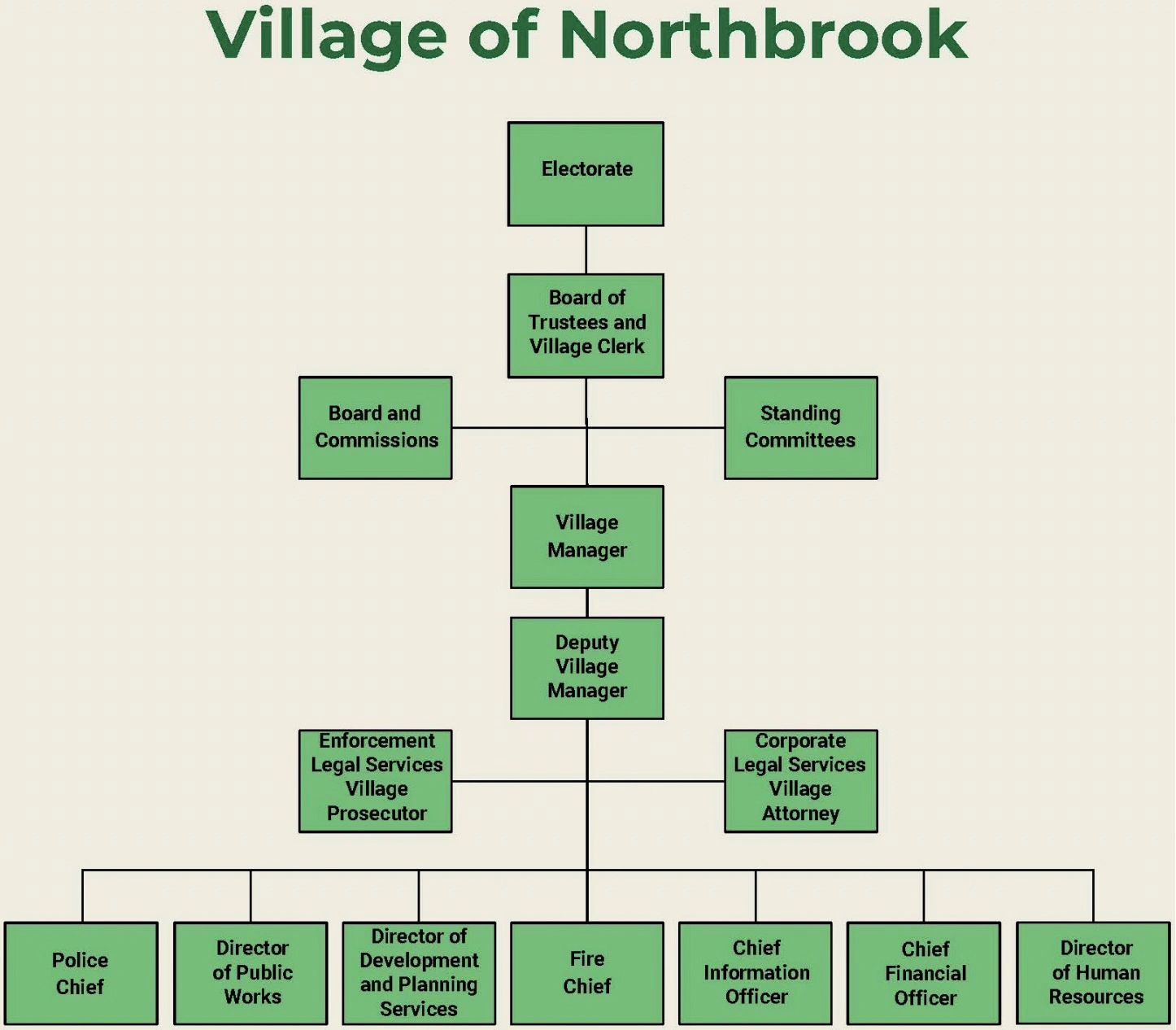
The fiscal year 2027 org chart elevates both the Communications and Human Resources departments to report directly to the Village Manager alongside the Deputy Village Manager.
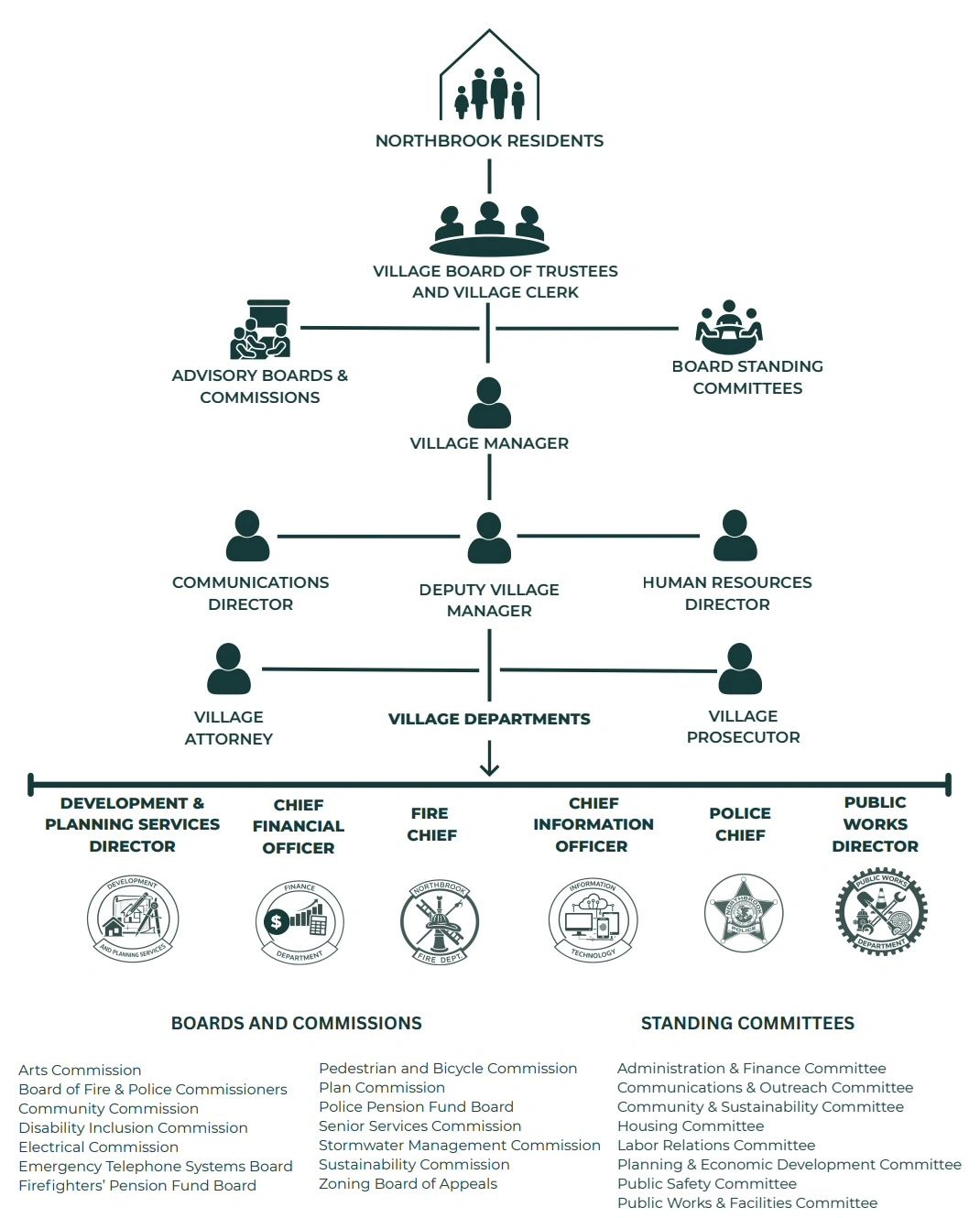
In a private sector context, the Village Manager functions much like a CEO, accountable to a board, responsible for operations, and building the right leadership team. Most CEOs of organizations Northbrook's size would have multiple direct reports across functional areas. The expansion of the Village Manager's direct reports to include Communications and Human Resources reflects a maturing organizational structure and an implicit statement about what the Village Manager considers strategic priorities worth direct oversight. That said, even with this expansion, the structure still seems light by any reasonable measure, though I will acknowledge I have not done a systematic comparison of how other similarly sized villages structure their leadership teams before making that observation.
Communications Director
The Village is hiring its first ever Communications Director, reporting directly to the Village Manager, at an all-in compensation of nearly $220,000. The job posting describes four core goals: more proactive and story-driven communication across all channels, improving resident understanding of Village services and decisions, strengthening community trust through transparency, and aligning communications with the Strategic Plan. The role will manage press releases, newsletters, the website, social media, the government access channel, and media relations, and will serve as Public Information Officer during emergencies.
Beneath the Communications Director sits a Communications Manager, who in turn oversees the Community Engagement Specialist positions. As referenced above as part of the fiscal year 2027 plan, a second communications position (Community Engagement Specialist) will also be added to the communications team, reporting to the Communications Manager, though it has not yet been posted publicly, likely awaiting the incoming director.
The Village clearly has communications challenges so adding the role is not surprising, but I do not have a fully formed opinion about this overall. The salary is substantial, and whether it is warranted depends on what the Village actually gets from the position, something that will only become clear over time.
What I am more confident about is what this hire will not fix. Northbrook has had a board-to-resident communication problem for years. What I want is simple: trustees who tell residents the truth — even when it is awkward, even when colleagues disagree, and even when it means acknowledging that Village staff could have done a better job. We need trustees willing to think critically and speak independently, even if the resulting vote will still be 5-1 against. No staff position, however talented, can substitute for that. A Communications Director oriented toward communicating on behalf of Village administration, explaining what staff is doing, how services work, and presenting the Village's work clearly and favorably, is doing a different job entirely. It may be a useful function. But it is not a substitute for trustees willing to speak plainly to the people they serve.
I will follow up about Village communications in a future post. The Board recently reviewed recommendations from the communications firm the Village Manager hired, the same firm that was the architect of the True North campaign a few years ago. How those recommendations address, or don't address, the board-to-resident gap will be worth examining.
Economic Development Coordinator
If you have read this far, the case for someone being responsible for economic development has already been made: through the incentive portfolio without a strategic framework, the Northbrook Court uncertainty, the online sales tax limitation, and the pressing need for non-resident revenue. This role was a key recommendation of the Economic Strategy Commission. Supporting economic development was the number two priority of Northbrook residents in the 2025 Social Pinpoint Community Survey conducted by BerryDunn as input to the Strategic Plan. Village communications was sixth, for what it is worth.
Enough said. This hire is overdue. The question is whether it is structured to deliver.
The job description is substantive: business attraction and retention, incentive program administration, Tax Increment Financing and Special Service Area support, market research and financial analysis, and liaison to the Economic Strategy Commission. Starting salary is $120,000 with an all-in compensation of over $160,000, which, given the scope of the role and the salaries of the other positions being added, seems modest.
The reporting structure is also concerning. This role will report to the Director of Development and Planning Services, who doesn't even report directly to the Village Manager. For such a key role, having it report three layers removed from the person ultimately accountable to the Board is at odds with the expectations of the role.
Development and Planning Services has to date mostly been a regulatory and process organization. Its core function is reviewing applications, issuing permits, and enforcing zoning. It is by design reactive. Economic development, by contrast, is inherently proactive: business attraction, incentive deal-making, redevelopment support, downtown vitality strategy.
Placing a proactive strategic function, especially in an area where the Village has consistently struggled to deliver results, inside a reactive regulatory department is an interesting choice, and one that when combined with the reporting concerns above raises questions about whether this position is truly structured as a strategic priority. That is not a criticism of the Director, who by all accounts is highly capable.
Time will tell if we are able to attract and activate the right talent, but a lot is riding on this role to be successful.
7. How a Neighboring Community Builds Its Budget — and What Northbrook Might Learn
I sometimes hear that my observations about Northbrook government are rooted in a fundamental lack of understanding of how government works. I've been critical here, so to remedy that I went looking for other examples from surrounding communities.
Glenview was the first one I looked at, and the contrast with Northbrook's is striking.
As noted above, in Northbrook the Board appears to see the budget for the first time when it is already largely complete, presented to the Administration and Finance Committee in March with a month to go before the vote. The public can attend that meeting, but only to observe. By the time any meaningful review could happen, the document is fully formed.
Glenview, by contrast, describes the budget as "the most important work product the Village Board must develop and approve every year." Their process begins in April, three months into the fiscal year, with the development of a five-year forecast. Staff uses that plan and takes a zero-based budgeting approach, meaning every department starts from scratch each year rather than incrementally adjusting last year's numbers, forcing a genuine ground-up review of all expenditures. And critically, the formal public budget cycle kicks off in the fall through three public workshops where staff presents detailed presentations to enable conversation between the Board and residents about revenues, expenses, and capital projects, well before the budget is finalized.
Glenview holds the same Aaa bond rating from Moody's that Northbrook does, runs a balanced budget, publishes a plain-language "Budget in Brief" alongside the full document, and releases a five-minute YouTube video summarizing the final budget for residents who are not going to read hundreds of pages. That last one in particular feels like low-hanging fruit, and perhaps something that will fall under the remit of Northbrook's new Communications Director.
I doubt Glenview residents as a whole are actually better informed about their budget than Northbrook residents are about theirs. But I suspect they trust the process more.
Conclusion
There is a lot here but it is worth reiterating that Northbrook's finances are genuinely in good shape. The General Fund is projected to carry a fund balance of just over $26 million at the end of fiscal year 2027. All Village funds are presented as balanced. No fund is projected to carry a negative reserve balance at April 30, 2027. The staff that produces a 384-page budget document and keeps the Village's finances in that condition deserves real credit.
But there is also cause for concern as we look ahead. Property tax bills are likely to keep rising. Pensions are underfunded and the capital projects are necessary and long overdue but expensive. Those obligations are already locked in. The only real lever available to offset them is growing the tax base. Northbrook Court and downtown revitalization are unsolved. The Village needs to be solving for more non-resident spending in Northbrook if we are going to lessen the pressure on property taxes. It is great that we are finally hiring a person to take the lead on economic development but I am very concerned we are not setting that person up for success. And having more professional communications is certainly good but there needs to be substance to communicate.
I opened this piece noting that most residents have no idea what is happening, and that zero public comments on a $180 million budget and a 12.3% tax increase is a reflection of where civic engagement in Northbrook currently stands. I suspect that rising tax bills will at some point change that. The tipping point may arrive sooner than anyone expects. When it does, residents will want answers. The question is whether the Board will have changed the narrative and built the kind of transparent, plain-language public record that will make those conversations productive, or whether they will be scrambling to find their footing with a constituency that feels blindsided.
I don't love everything about the plan they are executing but I do appreciate the challenges Northbrook is navigating and that there are no easy answers. Ultimately, I am rooting for it to work.
The fiscal year 2027 budget is publicly available at the Village of Northbrook website. All figures cited here are drawn directly from Village documents.