We’ve all seen what happens when local politics starts to feel like national politics: suspicion, tribalism, and personal attacks begin to replace collaboration, listening, and shared purpose. While elections often slide into races to the bottom, this one has gotten strangely personal. These are, after all, our neighbors—but we’re now knee-deep in debates over which side is more transparent, what the proper vetting process is (I always thought that was solely the job of the voter), whose Facebook page is private, who has a plan, who just complains, and who blocked whom first.
It’s exhausting—and more importantly, it distracts from what actually matters. I sincerely hope that, whoever wins, they take real steps to unite the community in a way that simply didn’t happen after the last election (which, from what I understand, was even more bruising than this one).
So, if only to amuse myself (not sure who actually reads these), I’m writing this post about the single largest source of revenue for Northbrook’s general fund: sales tax.
This issue has become a cornerstone of the Northbrook Caucus campaign as they make the case for four more years. Their message of “thoughtful growth”—and the numbers they’ve shared to back it up—suggests that the Village’s economic engine is revving and poised to accelerate further. This piece takes a closer look at those claims and dives into the details behind the numbers.
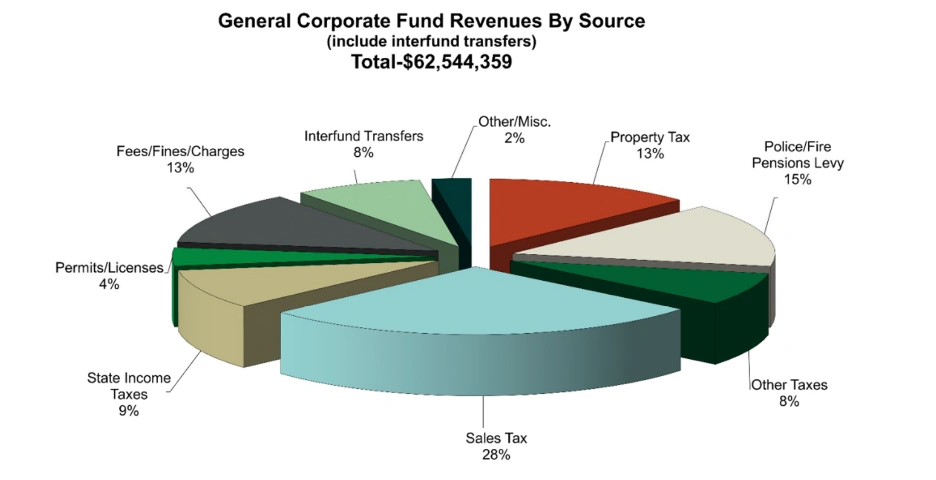
As the chart below shows, the primary revenue sources for the Village’s General Corporate Fund in Fiscal Year 2025 are: Sales tax (28%), property tax (13%), and Northbrook’s share of the state income tax (9%).
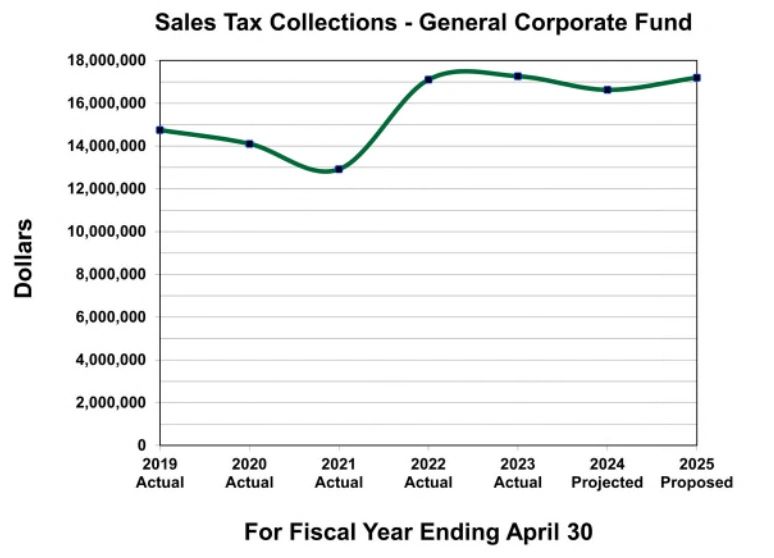
Let’s start with a look at the big picture. The chart below shows Northbrook’s annual sales tax revenue since FY’2019. At first glance, it looks like a steady climb—with a strong rebound after COVID in FY’22 and then relatively flat from there. But that visual can be misleading without some important context. In FY’22, Northbrook began collecting online sales tax from remote sellers, thanks to a change in Illinois law. That new stream of revenue, which started at about $1.7 million and has grown each year since, gave the Village a meaningful boost—but it also makes comparisons to pre-2022 numbers less apples-to-apples than they might appear.
As part of its 2025 campaign platform, the Northbrook Caucus slate has highlighted:
Thoughtful growth: Sales tax revenues make up 32% of the Village's budget. Despite high inflation and high interest rates over the last four years, sales tax revenues have continued to climb for the Village (up 5.8% from last year and 12.7% when compared with the average over the previous four years) and we have had many exciting new businesses open this year. This is due to intentional work on the part of the Village to make Northbrook more business-friendly.
They've echoed this messaging on social media, writing: "5.8% growth from retail sales tax last year. This year we are on track for 7% growth for the first 7 months!"
Full disclaimer for context: the Village’s fiscal year runs from May 1 to April 30. We’re currently nearing the end of FY’2025, so I’m interpreting “last year” as FY’2024 and “the average over the previous four years” as FY’2020 through FY’2023. It’s possible a different timeframe is being used, but this is how I understand it based on the Village’s fiscal calendar and where we are today.
That's excellent news-especially given the long-term downward trend at Northbrook Court, which has historically been one of the Village's top sales tax generators.
The growth is attributed to a long and encouraging list of businesses that have opened, relocated, or expanded in the Village over the past year. Here's the lengthy list that was posted on social media:
- Fresh Market
- J Crew Factory
- Thredz Spa (Northbrook Court)
- Luciana's Kitchen
- Agrazia
- Landmark on the Hill
- Hi-Five Summer Camp
- Lucid Pop-Up
- Toyota on Edens
- Tesla
- Lazy Dog
- Cabo
- Barnes and Noble
- Pure Car Wash
- Book Bin (expansion)
- North Shore Bistro
- Vasa
- Bell Flavors & Fragrances (expansion)
- Restoration Hardware
- Buffalo Wild Wings To Go
- Forza Cucina
- Epic Burger
- Moksha Indian Grill
- Protein Bar + Kitchen
- Noggin Builders (relocation & expansion)
- Claim Company (relocation)
- Celebree School
- EverSmiles Orthodontics
- Skale Dental Professionals
- Nuance Health & Wellness MedSpa
- City Wide Facility Solutions
- Jaffa
- rhelge glass art
- Buddha Warrior
- Thread & Wax Spa
- Hoops Heaven
This list reflects a lot of activity, and that’s genuinely encouraging. But a little caution is warranted. Several of these openings appear to be replacements for businesses that closed—like Meatheads, Marcello’s, and Granite City—so they may represent revenue replacement rather than true growth. At least one business on the list, Protein Bar + Kitchen, opened back in June 2023, meaning it likely doesn’t contribute new tax revenue this year.
There’s nothing wrong with a little overexuberance when we see green shoots. But a more detailed breakdown—by opening date, business type, and projected net fiscal impact—would go a long way in helping residents understand the real story. To be clear, I didn’t verify every listing, but the pattern is enough to raise fair questions.
In search of some deeper analysis, I turned to the Village website. The recently published FY’26 proposed budget includes updated projections for sales tax revenue—and for the first time in several years, the numbers suggest real momentum.
The chart below highlights two key takeaways:
- FY’25 sales tax revenue is now projected at $17.7 million, exceeding the original budget of $17.2 million by 2.9%, and marking a 4.4% increase over FY’24 actuals.
- FY’26 is projected to rise further—to $19.5 million, a 10.2% year-over-year increase from the FY’25 projection.
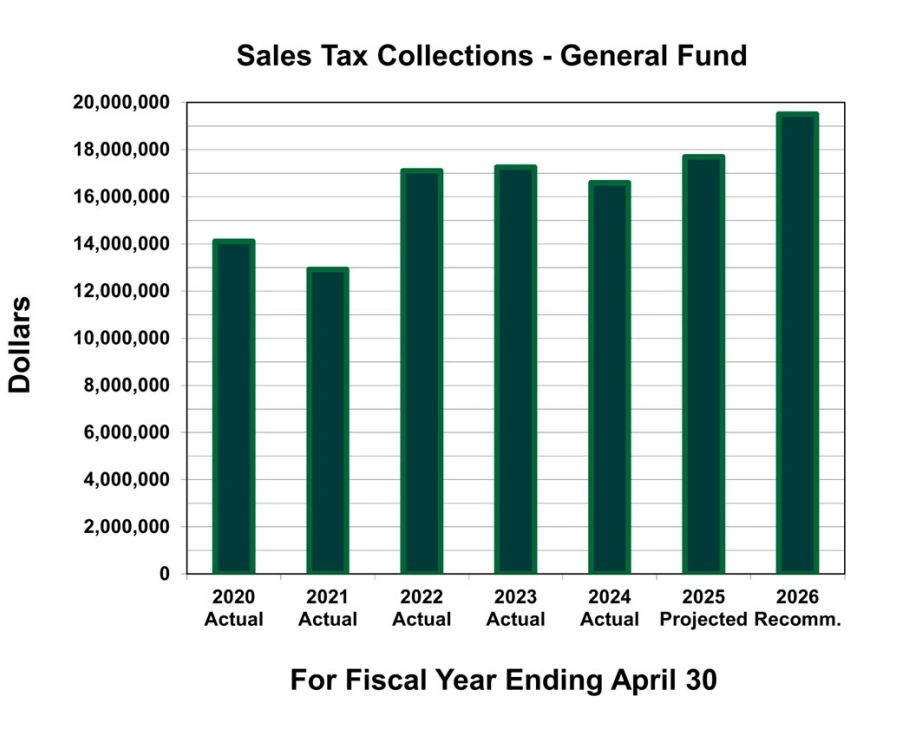
That’s absolutely worth celebrating. It would mark the first meaningful year-over-year growth in quite some time—and the projected increase is substantial. Even more encouraging is that the proposed budget includes a clear explanation for the FY’26 jump: Sales tax in FY 2026 budget to exceed with the FY 2025 projection. This is due to the addition of new businesses in Northbrook.
The Village budget is a public planning document prepared by professional staff—not a political campaign statement—so this kind of growth attribution should give residents confidence that the forecast is grounded in real, measurable economic activity.
At the same time, it’s worth noting that, because FY’25 is not yet complete (with just over a month remaining), the Village hasn’t yet published its full-year financial analysis. In fact, the most recent available data only goes through July 31, 2024—the end of Q1.
Still, by looking back at the FY’22 through FY’24 sales tax breakdown by shopping area, some clear trends emerge about where the revenue is (and isn’t) coming from:
- Downtown: modest growth (~$1.2M → ~$1.3M)
- Online Sales: strong growth (~$1.7M → ~$2.2M)
- Northbrook Court, Village Square, Willowfest: trending downward
- Sanders Court: flat and low overall
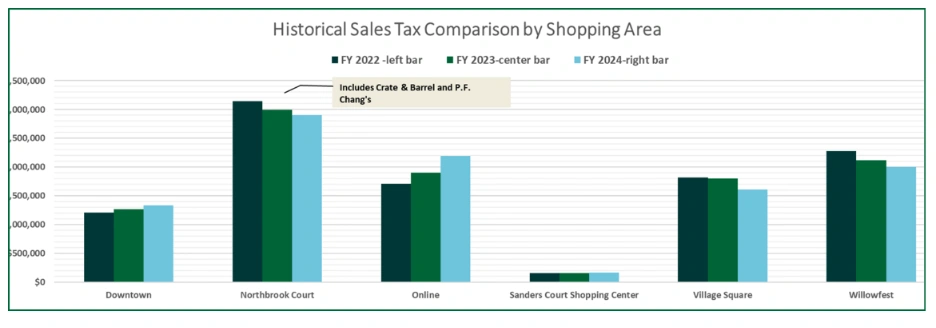
We know that—even with some of the newly listed businesses located at Northbrook Court—that property will not be meaningfully increasing its contribution to our tax base anytime soon. And that matters. For decades, Northbrook Court was the Village’s single largest generator of sales tax revenue. Its continued decline leaves a noticeable gap—one that we’re still working to fill elsewhere.
It’s part of the reason I started digging into these numbers in the first place.
Since launching Engage Northbrook earlier this year, I’ve tried to take an honest look at what’s happening in our community. I’ve been critical when I felt it was warranted, and even when I’ve shared good news, there’s usually been a “yeah, but…” that follows. This feels like one of those times.
The FY’26 outlook is encouraging, and some of the business activity we’re seeing is a positive sign. But there are still a few numbers being touted publicly that I just can’t reconcile with what’s in the Village’s own budget documents.
Consider again the campaign claims:
- This year we are on track for 7% growth for the first 7 months!
- 12.7% when compared with the average over the previous four years.
- 5.8% growth from retail sales tax last year
The first is admittedly a small thing, but still a bit confusing. The claim that sales tax is up 7% through the first seven months of FY’25 appears to be accurate—if anything, based on the Village’s month-by-month breakdown, the actual increase looks closer to 8%. That’s genuinely encouraging. But if we’re up nearly 8% through seven months, why does the full-year projection—published just this week—show only 4.4% growth for the year? That would require a noticeable slowdown in the final five months, which seems unlikely, especially when the same budget projects a 10.2% jump in FY’26. Again, it’s a minor inconsistency, but one I’d like to understand better.
The second point is more serious. The claim that FY’24 sales tax revenue is 12.7% above the four-year average doesn’t hold up to the data. Based on the numbers available, the actual increase is closer to 8%. But that figure is inflated by how the “four-year average” is calculated. Including FY’20 and FY’21 in the average is misleading for two big reasons. First, FY’21 was significantly impacted by COVID and was abnormally low. Second—and just as important—is that starting in FY’22, Northbrook began receiving a new revenue stream thanks to a change in Illinois law: online sales tax from remote sellers. This tax is destination-sourced, meaning that when a purchase is delivered to a Northbrook address, the retailer must apply Northbrook’s tax rate and remit it to the Village. That’s added over $1.7 million annually. So when you combine the artificially low baseline years with the boost from online sales, the 8% figure is dramatically overstated. Presenting it as part of a campaign message without that context feels, frankly, misleading. If anything, correcting for those factors, we are essentially flat to FY’2019—which, to be fair, isn’t a bad message at all. It shows that the Village has weathered COVID and offset the decline in Northbrook Court’s contribution, even if we don’t get “credit” for the impact of the state law.
The third point is the most clear-cut. The statement that sales tax revenue is “up 5.8% from last year” simply doesn’t match the Village’s own numbers. If “last year” means FY’24 compared to FY’23—as it appears to—then the claim is incorrect. FY’24 came in 4.2% below FY’23. I also checked the numbers on a calendar-year basis—comparing full-year 2024 to full-year 2023—and the result was still a decline of 3.3%. If there’s a different methodology or timeframe behind the 5.8% figure, I’d welcome clarification.
These aren’t just technical disagreements—they’re public claims being used to define the narrative of our Village’s economic health. And again, I could be missing something. All of the numbers I’m referencing come directly from the Village’s budget documents and financial summaries (and, in fairness, some of the numbers vary from document to document but not enough for significant change to the overall analysis). If there’s more to the story, I’d love to hear it—not in a condescending “Fact Check Friday” kind of way, but in a genuine conversation that respects the time people are taking to understand what’s really happening. The goal isn’t to nitpick—it’s to stay grounded in facts, ask honest questions, and keep the focus on what’s best for Northbrook.
There’s a lot to be encouraged by in the latest data—Northbrook appears to be stabilizing after several flat years, with a projected rebound in FY’25 and a meaningful jump in FY’26. That’s good news for the Village and a sign that new businesses and broader recovery may finally be showing up in real numbers.
At the same time, it’s disappointing to see some of the public claims being made—whether in the Caucus platform, on social media, or in responses to The Northbrook Patch—don’t align with the Village’s own data. These aren’t harmless exaggerations; they create confusion at a time when residents are trying to make informed decisions about the direction of our community.
We don’t need spin. The actual numbers tell a perfectly respectable story—one of resilience, steady recovery, and the potential for meaningful growth ahead. Let’s keep the conversation honest, because Northbrook deserves that.
And obviously, if I’ve gotten something wrong, I’ll update this piece to reflect that and republish.
PS - Three more days of early voting and then election day is April 1st! Please make your plan to vote, if you have not already.