Editor's Note - The Village Board did publish the agenda for the May 12th meeting after this was posted, and the sale of Grainger is on the agenda.
According to the 2025 BerryDunn Community Survey, Northbrook residents' top priority for the Village's strategic plan is expansive retail, dining, and shopping options. When asked what one thing would most improve their quality of life, the #1 answer — by more than double the next response — was revitalizing downtown and Northbrook Court. And their biggest concern? Redevelopment and growth.
The confidence numbers are equally telling. Only 5% of residents are very confident Northbrook will be a better place to live in three years. Among those who aren't confident, downtown and Northbrook Court revitalization would change their minds — but so would leadership, governance, and board change, at nearly the same count. Many appear to be hoping for different leadership to get them there.
When asked what makes Northbrook distinct compared to surrounding communities, the #1 negative response was that downtown lacks energy, restaurants, and retail. Residents know exactly what we are missing. It turns out there are quite a few reasons why.
Northbrook's downtown has some built-in disadvantages. Train tracks run directly through the center. A large park sits mostly empty, offering no commercial value. School-related traffic chokes access during peak hours. Parking is limited. Unlike neighboring communities, Northbrook's downtown crossroads are not major arteries that attract a lot of pass-through traffic. For some, this is a feature. For downtown revitalization, it is a bug.
The even larger issue is downtown density. Without built-in foot traffic, businesses are reluctant to plant their flag here. I have known this intuitively, but numbers have a way of making their case more plainly than intuition does.
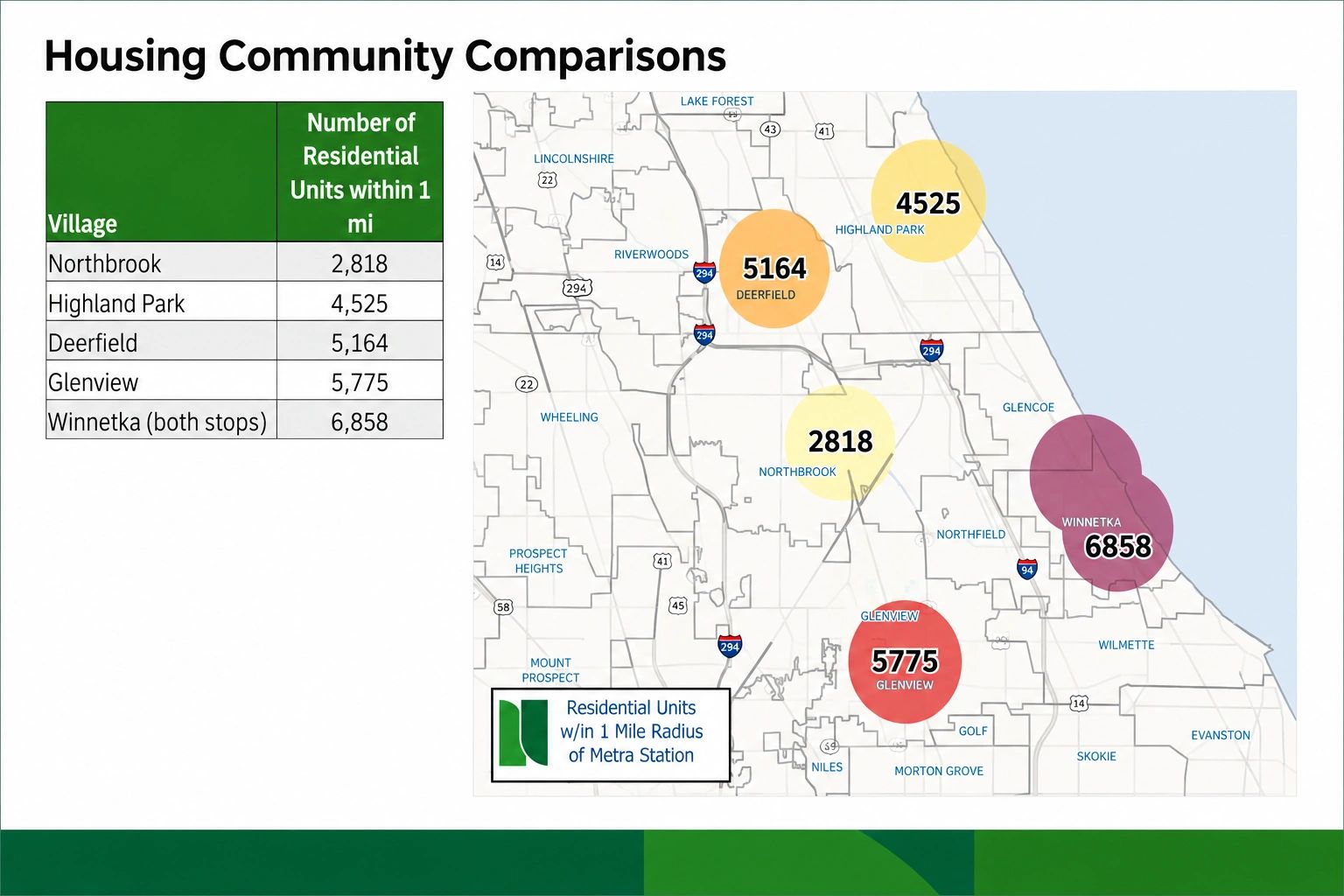
Buried at the end of the last Board meeting, the "Presentation to Review Updated Metrics and Statistical Information on Northbrook Downtown" made the issue plain. Within one mile of the Northbrook Metra station, there are 2,818 residential units — compared to 4,525 in Highland Park, 5,164 in Deerfield, 5,775 in Glenview, and 6,858 in Winnetka (both stops).
The composition of that housing stock makes the gap even harder to close. Northbrook is 78% single-family and only 22% multi-family — well below the 35-45% typical of comparable communities, and a further explanation for why our density numbers look the way they do. The double whammy is that with a median age of nearly 50 — the highest among North Shore peers — 58% of our households are one or two people. Aging residents who want to stay in Northbrook but no longer need a large home have nowhere to downsize to, which means fewer single-family homes turning over to the young families the community needs to attract.
Of the sample set, we are last. Not close to last — last by a meaningful margin. We trail Deerfield by nearly 2,400 units. Even Highland Park, which no one would describe as a dense community, has 60% more housing within a mile of its station than we do.
That's our downtown's built-in customer base — the people close enough to walk to Sunset, grab lunch on Shermer, stop into a shop on a Tuesday afternoon. When a business evaluates where to locate — whether it's a franchise running demographic models or a local restaurateur doing the math on a napkin — they're asking the same question: how many people live close enough to become regular customers? Northbrook's answer to that question, relative to every comparable North Shore community, is: not enough.
There is less than zero chance we get downtown revitalization without increased density. The key downtown sites have to be part of the solution — Grainger, long overdue to get off the Village's books, and Heitman, a property that has been for sale for what feels like forever. Northbrook Court is a separate but related challenge — after years of optimism we were instructed to expect no progress there in 2026 — and its decline has only made a vibrant downtown more urgent.
Hopefully the Village will relax the 15% affordable requirement, which as I have noted in this series makes Northbrook less attractive to developers than surrounding communities. That would help get these projects moving at a pace unfamiliar to Northbrook. But leadership will still have to dig deep and actively sell this to the community because the familiar objections around traffic, scale, schools, process, and neighborhood character will return quickly. Northbrook has demonstrated a willingness to work against its own economic interests before. The failed Walmart proposal on the east side of town is the obvious example — a non-downtown site that could have generated meaningful sales tax revenue, much of it from non-Northbrook residents. How good would that revenue look on our books today?
Many will remember how the most recent chapter in the Grainger saga went: a four-and-a-half-hour board meeting, 22 of 30 public speakers in opposition, a petition with 1,000 signatures, a unanimous Plan Commission denial, and a board vote at 12:53am that approved the project anyway. The concerns then, as they will be again, centered on traffic on Shermer, scale, and a community that felt it hadn't been given a genuine opportunity to engage before the decision was effectively made.
Density comes with tradeoffs. More housing near downtown means more traffic on Shermer and the surrounding streets. It may mean more children in already-stretched schools — and potentially a new one. It means more crowding, more demand on infrastructure, more change to the character of neighborhoods that border the development sites. None of that is a reason to say no — and I have made the case elsewhere in this series that our pension liabilities and facility modernization costs mean we essentially have to say yes.
We are caught in a vicious cycle. The Board has not found its footing connecting with the community, when that connection is precisely their job. Residents, meanwhile, barely turn out to vote and often enter these debates late, angry, and under-informed. The Village's own survey makes this plain — the #1 barrier residents cited to engaging in community life was perceived partisanship, closed-door decisions, and an unresponsive board. The board isn't just failing to break the cycle. In the eyes of many residents, they are the cycle. Which makes it all the more striking that when the Village's own consultants interviewed the Board of Trustees, community engagement and communication topped their list of concerns too. The board knows the problem. They named it themselves.
The case for density is what the Village needs to make before the next development application reaches the board — not after the room is already divided, and not at the end of a two-hour meeting with a closed session still waiting.
Which is what makes the April 28th presentation such a missed opportunity.
The Village had a clear story available. Start with the BerryDunn survey — residents want downtown and Northbrook Court revitalization above all else. Then make the connection: businesses choose locations with ready-made customer traffic, and on that measure Northbrook trails every comparable community on the North Shore. Instead, the presentation was jammed in at the end of a long agenda, skipped slides, and was not included in the agenda packet — the only thing in the packet was three sentences of background describing what it framed as a routine twice-annual economic indicators review, a claim I could not verify, having searched every 2025 Village Board agenda without finding a prior instance.
More than a week later, despite specific requests by a trustee and the president that it be posted, it still isn't on the Village website. The president liked the data so much that she recommended the Director do a voiceover video explaining it — a good instinct, and an even better one if a trustee rather than staff delivered it. I have emailed and asked for the presentation with no success.
One of the nuggets in the presentation was that two preliminary review applications for multi-family development are headed to the board in May. They were not named. I have no inside knowledge, but if I had to bet, I'd expect one is the old Bank of America building on Shermer and the other is Grainger.
In that sense, I would assume this presentation was put on the agenda to start to re-make the case for proceeding with these additions to the downtown. Unfortunately, it's hard to envision a worse approach to priming the community for what's coming.
The concept of Northbrook needing more density is not new, of course. It's been in the comprehensive plan since 2010. It's in the downtown plan. It's in the Economic Strategy Commission's recommendations. The case has been consistent — we just have not done anything about it.
Perhaps it was just as well then — the presentation was not framed as I suggest above and the progress narrative at the start served to underscore that we continue to struggle. The presentation kicked off with an acknowledgement that residents assume nothing's happening with the downtown because they haven't seen it yet. Whether the progress list presented that evening — a parking analysis, wayfinding banners, an economic developer being recruited, zoning code updates, phase one streetscaping — was intended to reinforce resident opinion that nothing is happening downtown, or refute it, was unclear. What is clear is what wasn't on the list.
When the Village published its Downtown Revitalization FAQ alongside the Hometown Coffee agreement in November 2024, it included a specific implementation timeline. Among the commitments: a downtown design RFP to be issued by March 2025, a business investment pilot program drafted and launched by March 2026, regular ESC engagement beginning December 2024, and a board-led process to explore a downtown nonprofit launching May 2025. The streetscaping is real and, other than some disappointing choices with the trees, looks okay — though as with any landscaping project, it often takes 2-3 years for it to take hold, and it has not yet. The rest of that list was not mentioned in the session and, unfortunately, not one trustee referenced any of it in the Q&A portion.
After much pomp and circumstance in late 2024, progress has been sparing. Even if my hunch about Grainger is right and we are finally, eight years later, in a position to sell it for redevelopment, the meaningful work is still ahead — orienting a community that named downtown revitalization as its top priority to the reality of what revitalization actually requires, and demonstrating that this time we can execute on what we say we are going to do. I am hopeful. But hope is not a strategy, and the hard work remains.
This is another post on Northbrook local government. Prior pieces on the Grainger property, the Economic Strategy Commission, and the Hometown Coffee deal are available on Engage Northbrook. The next post will look more closely at the amendment to the Hometown Coffee agreement approved earlier in the April 28th meeting. As always, if there are errors or important context I've missed, please flag it in the comments.